
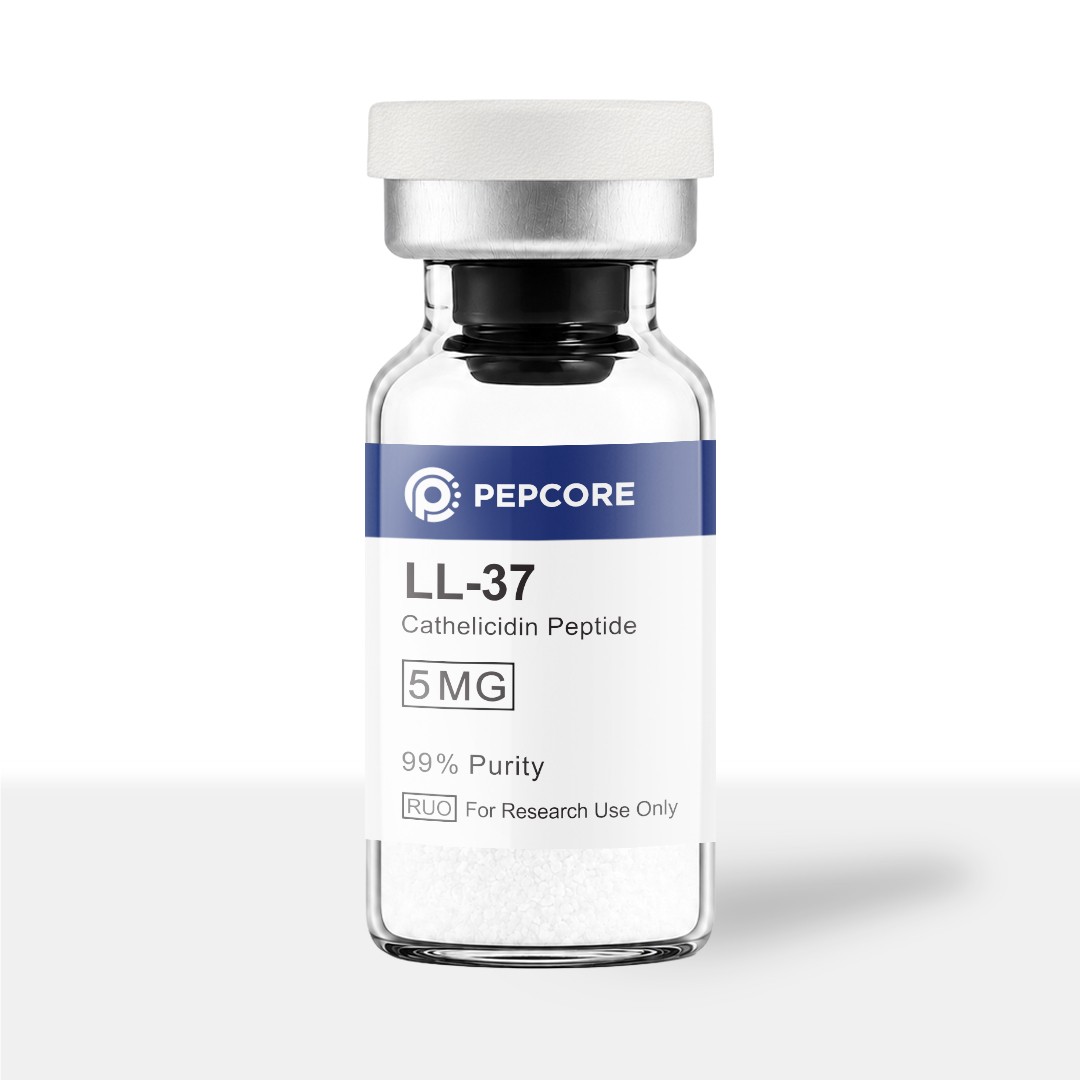
LL-37 is the body’s own antimicrobial peptide, the only cathelicidin humans make, released by immune cells and skin as a first line of defence. It is used in research on infection, biofilms, immune signalling and wound healing, where it is the reference molecule for the whole cathelicidin family.
LL-37 is studied for three things at once: how it breaks bacterial membranes, how it steers immune cells, and how it helps skin close wounds, all described in the core structural and functional literature (Dürr et al., 2006, Biochimica et Biophysica Acta).
Research Applications
- Studied in antimicrobial and biofilm models
- Relevant in wound-healing and skin-repair research
- Examined in innate-immunity and immunomodulation studies
- Applied in membrane-interaction and TLR-signalling work
Supplied as a lyophilized powder for stability.
See also: Thymosin Alpha-1, KPV, and GHK-Cu.
Scientific Background
Cathelicidins are a family of host-defense peptides released at sites of microbial challenge or tissue injury. Humans carry a single cathelicidin gene, CAMP, whose precursor hCAP18 is cleaved to release LL-37, a cationic, amphipathic 37-residue peptide named for its two N-terminal leucines.
In the presence of membranes or physiological salt, LL-37 adopts an α-helical conformation, which underlies its interaction with bacterial membranes, lipopolysaccharide and host cell surfaces. Research has described broad-spectrum antimicrobial activity, disruption of biofilm formation and binding of bacterial endotoxin.
Beyond direct antimicrobial effects, LL-37 is studied as a signalling molecule: it modulates Toll-like receptor responses, attracts immune cells and promotes keratinocyte migration and re-epithelialization in wound models. This dual antimicrobial and immunomodulatory profile makes it a widely used reference peptide in innate-immunity research.
LL-37 Structure
Peptide Class: Human cathelicidin antimicrobial peptide (synthetic, 37 amino acids)
Amino Acid Sequence: LLGDFFRKSKEKIGKEFKRIVQRIKDFLRNLVPRTES
Molecular Formula: C₂₀₅H₃₄₀N₆₀O₅₃
Molecular Weight: 4493.3 g/mol
CAS Number: 154947-66-7

Reviews
There are no reviews yet.