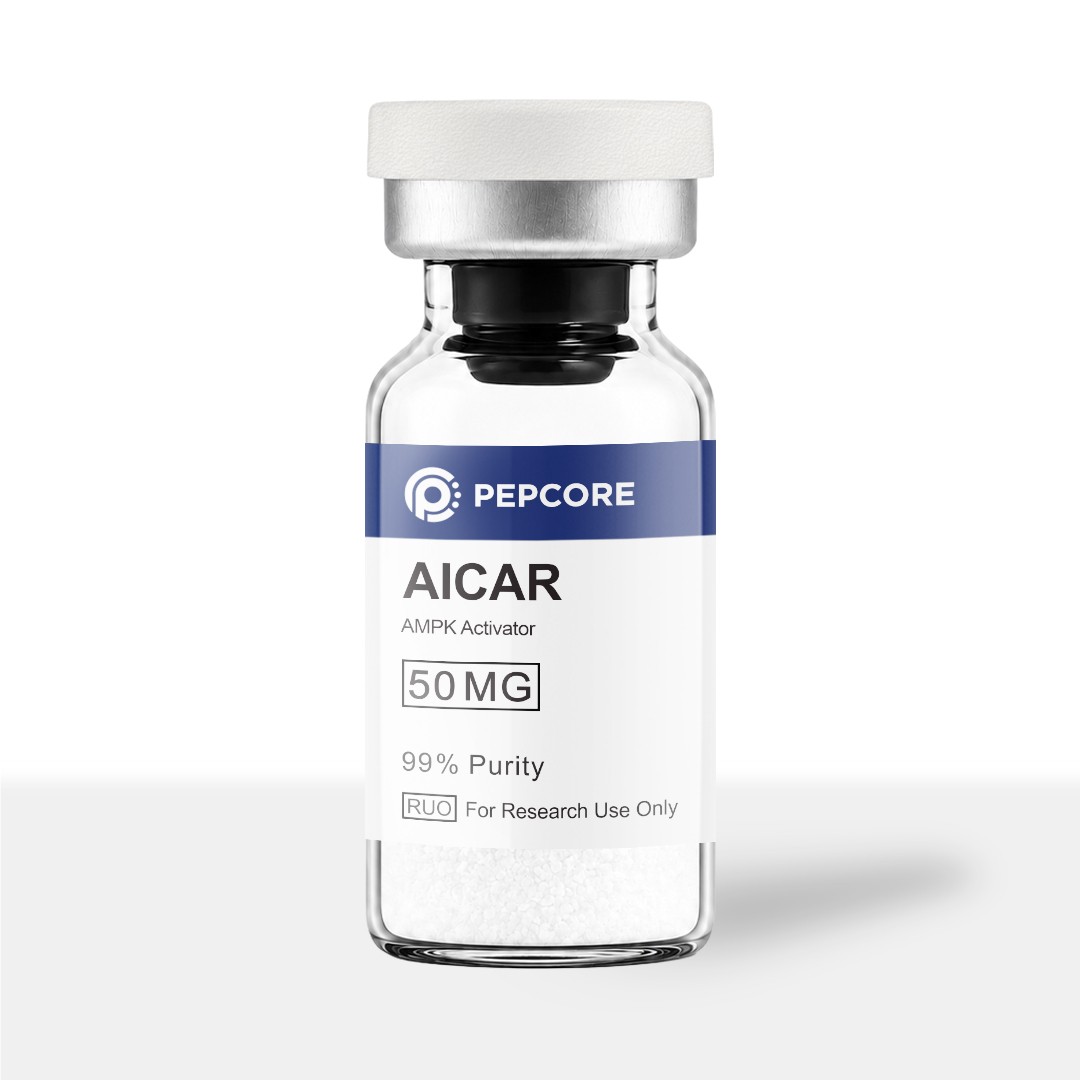
AICAR is a lab-made molecule that switches on AMPK, the enzyme cells use as their energy sensor. In research it is known as an exercise mimetic: it reproduces the signal muscle gets from training, which is why it is used in endurance, fat-oxidation and glucose-uptake models.
AICAR is studied for what AMPK activation does to muscle, liver and fat cells, with published work showing it raises running endurance and fatty-acid burning in laboratory models without any training (Narkar et al., 2008, Cell).
Research Applications
- Studied in endurance and exercise-mimetic models
- Relevant in research on fat oxidation and glucose uptake
- Examined in mitochondrial biogenesis and muscle-fibre studies
- Applied in AMPK and energy-metabolism signalling work
Supplied as a lyophilized powder for stability.
See also: 5-Amino-1MQ, MOTS-c, and AOD-9604 5 mg.
Scientific Background
AMP-activated protein kinase (AMPK) is the master energy sensor of the cell. When ATP falls and AMP rises, AMPK switches cells from storing energy to producing it, driving glucose uptake, fatty acid oxidation, and mitochondrial growth. Researchers needed a clean way to switch it on in the laboratory.
AICAR was established as that tool in the mid-1990s. Once inside the cell it is phosphorylated to ZMP, which mimics AMP and activates AMPK without changing the cell’s ATP, ADP, or AMP levels, so observed effects can be attributed to the kinase itself.
This selectivity made AICAR a reference compound across metabolic, muscle, and exercise-physiology research. Studies with it helped map how AMPK reprograms skeletal muscle toward an oxidative, endurance-type profile, work that gave rise to the term exercise mimetic.
AICAR Structure
Compound Class: Nucleoside analogue (AMPK activator)
Chemical Name: 5-Aminoimidazole-4-carboxamide-1-β-D-ribofuranoside
Molecular Formula: C₉H₁₄N₄O₅
Molecular Weight: 258.23 g/mol
CAS Number: 2627-69-2
Reviews
There are no reviews yet.