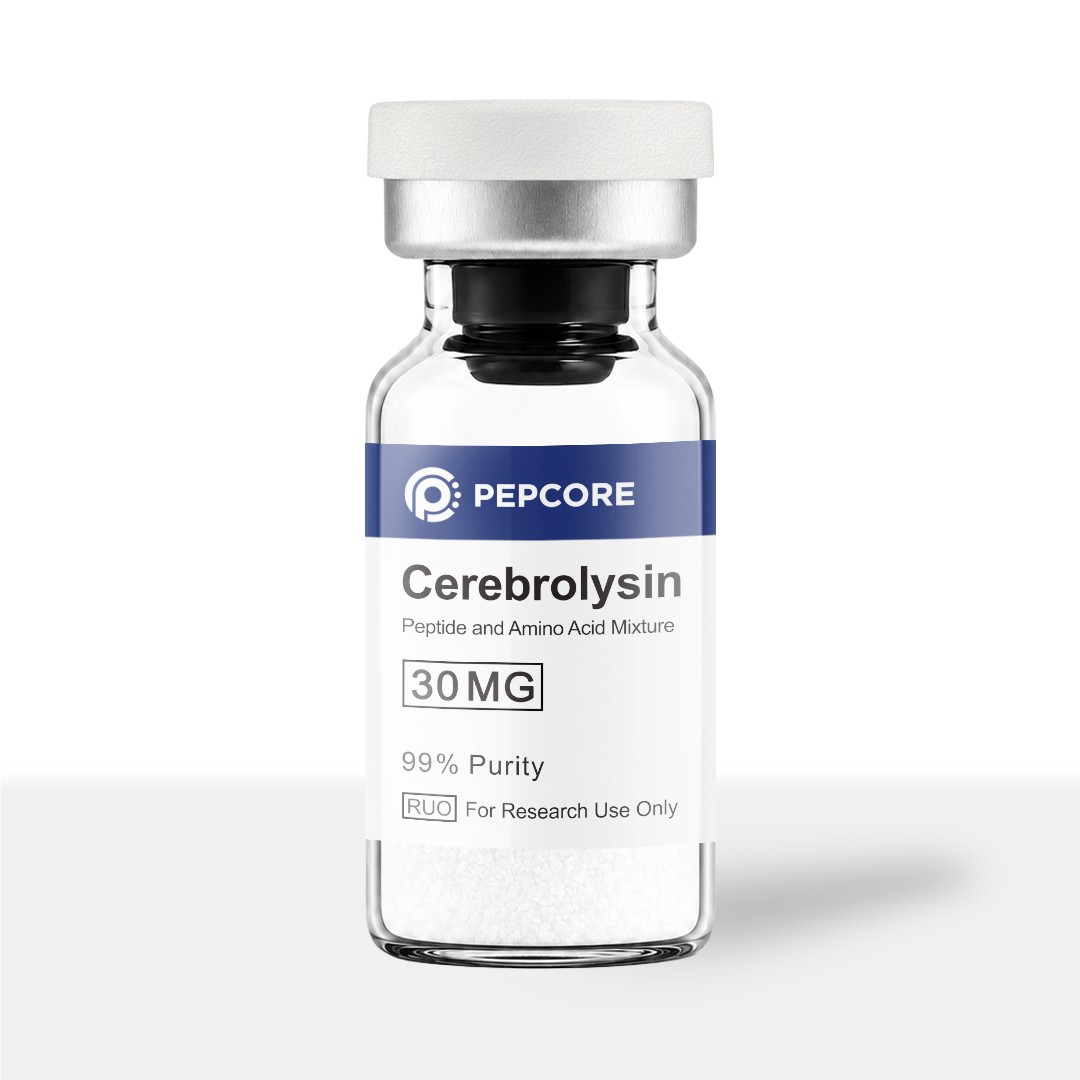
Cerebrolysin is not a single peptide. It is a standardised preparation of low-molecular-weight peptides and free amino acids produced by controlled enzymatic breakdown of purified porcine brain protein, and the mixture is the point: it is studied as a whole rather than as one molecule.
Its research base centres on neurotrophic signaling, with work characterising how the preparation engages neuronal survival and repair pathways (Masliah and Diez-Tejedor, 2012, Drugs Today). That has made it a long-standing reference preparation in neurological research.
Research Applications
- Neurotrophic signaling research
- Neuroprotection and neurorepair models
- Neuroplasticity and neurogenesis studies
- Cognitive research model systems
Supplied as a lyophilized powder for stability.
See also: Semax 10 mg, Selank 10 mg, and NA Semax.
Scientific Background
Cerebrolysin is produced by standardised enzymatic hydrolysis of purified porcine brain protein, yielding roughly 15% biologically active peptides below 10 kDa alongside approximately 85% free amino acids. It carries the development code FPF-1070 and has been under continuous laboratory investigation since the 1970s.
Unlike the synthetic single-sequence peptides that dominate this field, Cerebrolysin has no defined amino-acid sequence and no single molecular weight. Mass-spectrometry profiling of authentic material has resolved hundreds of distinct peptide species, so its characterisation rests on the behaviour of the preparation as a whole rather than on one molecule.
This has placed it at the intersection of neurotrophic-factor research, neuroprotection and neurorepair models, and cognitive research, where it is used as a reference preparation in laboratory investigations of neuronal survival and structural plasticity.
Cerebrolysin Structure
Peptide Class: Standardised porcine brain-derived peptide preparation
Amino Acid Sequence: Not applicable, mixture of low-molecular-weight peptides and free amino acids
Composition: Approximately 15% peptides below 10 kDa, approximately 85% free amino acids
Molecular Formula: N/A (mixture)
Molecular Weight: N/A (peptide fraction below 10 kDa)
CAS Number: 12656-61-0
Synonyms: FPF-1070
Reviews
There are no reviews yet.