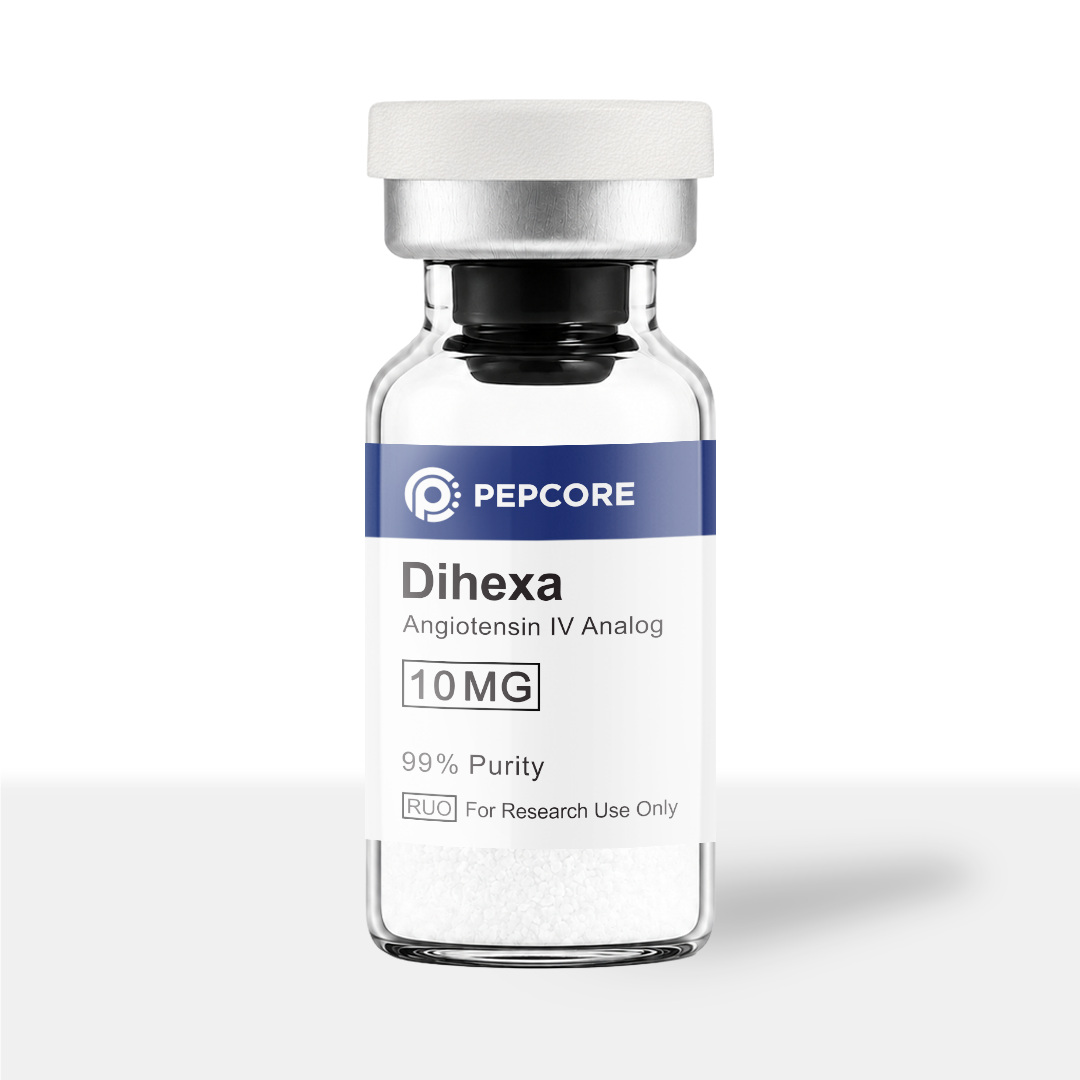
Dihexa (PNB-0408) is a small, metabolically stable analog of angiotensin IV built on a capped Tyr-Ile core. It crosses the blood-brain barrier in animal models and acts on HGF/c-Met signalling, which is why it is used in memory, synapse formation and neurodegeneration research.
Dihexa is studied for learning and synaptic connectivity, with work in APP/PS1 mice reporting restored spatial learning in the Morris water maze and lower inflammatory markers via PI3K/AKT signalling (Sun et al., 2021, Brain Sciences).
Research Applications
- Studied in memory and learning research models
- Relevant in research on synaptogenesis and dendritic spine growth
- Examined in neurodegeneration and brain injury studies
- Applied in HGF/c-Met signalling work
Supplied as a lyophilized powder for stability.
See also: Semax 10 mg, Cerebrolysin 30 mg, and PE-22-28 10 mg.
Scientific Background
Angiotensin IV (AngIV, Val-Tyr-Ile-His-Pro-Phe) is a fragment of the brain renin-angiotensin system that has long been linked to learning and memory in rodent models. Its value as a research tool was limited because the native hexapeptide is degraded quickly and does not readily cross the blood-brain barrier.
Work at Washington State University narrowed the active core of the analog Nle1-AngIV to its first three residues, Nle-Tyr-Ile, and showed that procognitive activity tracked with increases in dendritic spine number and spine head size. Further N- and C-terminal changes, designed to raise stability and hydrophobicity, produced Dihexa (N-hexanoic-Tyr-Ile-(6) aminohexanoic amide).
Dihexa reversed scopolamine-induced deficits in Morris water maze performance, improved performance in aged rats, and showed marked synaptogenic activity, which has made it a research tool in synaptic connectivity and HGF/c-Met studies.
Dihexa Structure
Peptide Class: Synthetic angiotensin IV-derived peptidomimetic (capped Tyr-Ile dipeptide)
Amino Acid Sequence: Hexanoyl-Tyr-Ile-Ahx-NH2 (Ahx = 6-aminohexanoic acid)
Molecular Formula: C₂₇H₄₄N₄O₅
Molecular Weight: 504.7 g/mol
CAS Number: 1401708-83-5
PubChem CID: 129010512
Synonyms: PNB-0408
Reviews
There are no reviews yet.